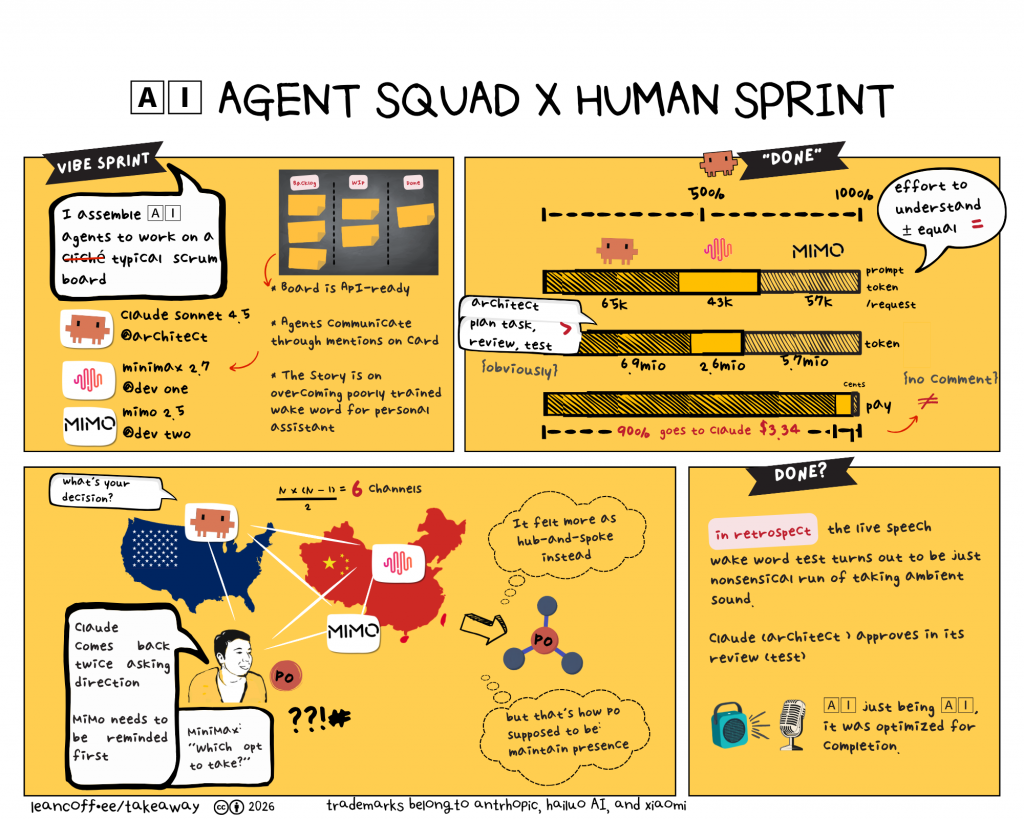
Instead of the Claude Code suggested fan-out sub agents, I assembled 🄰🄸 agents to work on a typical Scrum board, which was fairly human-readable, had familiar visual flow, hoping it would also match my―human―pace. This was preferable after some shortcomings of letting loose agent in the wild. The squad consisted of Claude Sonnet 4.5 as architect and two task takers: MiniMax M2.7 and MiMo-V2.5 (designed-in-California-assembled-in-China kind of thing). They needed to solve a rather architectural User Story (a.k.a Spike) for personal assistant project where a poorly trained wake word must trigger before this assistant went full listening mode.
I had laid-out some groundwork e.g. rule for task creation, card movement between lanes, how to communicate using comment mentions, down to preparing helper scripts for agents to be able to interact with the board’s API. As Product Owner (PO) I wrote up the User Story description with an explicit hint on how to test by themselves without human intervention―yet another expectation.
So architect and I started Sprint Planning. It proposed exactly two tasks, presumably inferring the howto of distributing tasks vs the number of available agents. Prior to that, I had instructed the other two to stand by for Sprint Backlog item assigned to them. Once I had come to an agreement with Claude, I needed to remind MiMo to start, while MiniMax behaved differently: asking whether to take over or clarify with architect. Either way, both resulted the same communication cost for me. It felt more as hub-and-spoke instead of equal path of communication from/to each. Six channels, but the weight was on me.
Still it hit me, that it had always been the way PO supposed to be, maintaining presence, not just maxing vision. In just few minutes (these agents were the fastest typists ever existed after all), architect came back twice asking direction, “What’s your decision?” I took a glimpse on the board and their Claude Code “chats” trying to deliberately make the call. But heck, this was just a “social” experiment anyway and shot the answer.
In retrospect, after a few days I revisited their work. The live speech wake word test―which I had expected to use the method described―turned out to be just nonsensical run of taking ambient sound and the architect had it approved in the review, no questions asked. It proved that 🄰🄸 just being 🄰🄸, it was optimized for completion. The token usage data also offered some insights. Claude clearly had made most of the effort, but if each agent effort is normalized as prompt token per request, they had worked equally as hard, but not any harder. Note to self: the Sprint wasn’t timeboxed, I simply decided to stop spending dollars on tokens, thus, Sprint ended. Ironically, I also revert to command-and-control for the same reason, now vibing with one agent at a time.